World Biofuel Day – “The Compliance Landscape of Biofuels: Policies, Challenges, and Global Standards”
“Sustainable biofuels are not just fuels; they are a bridge between today’s energy needs and tomorrow’s low-carbon future.” – International Energy Agency
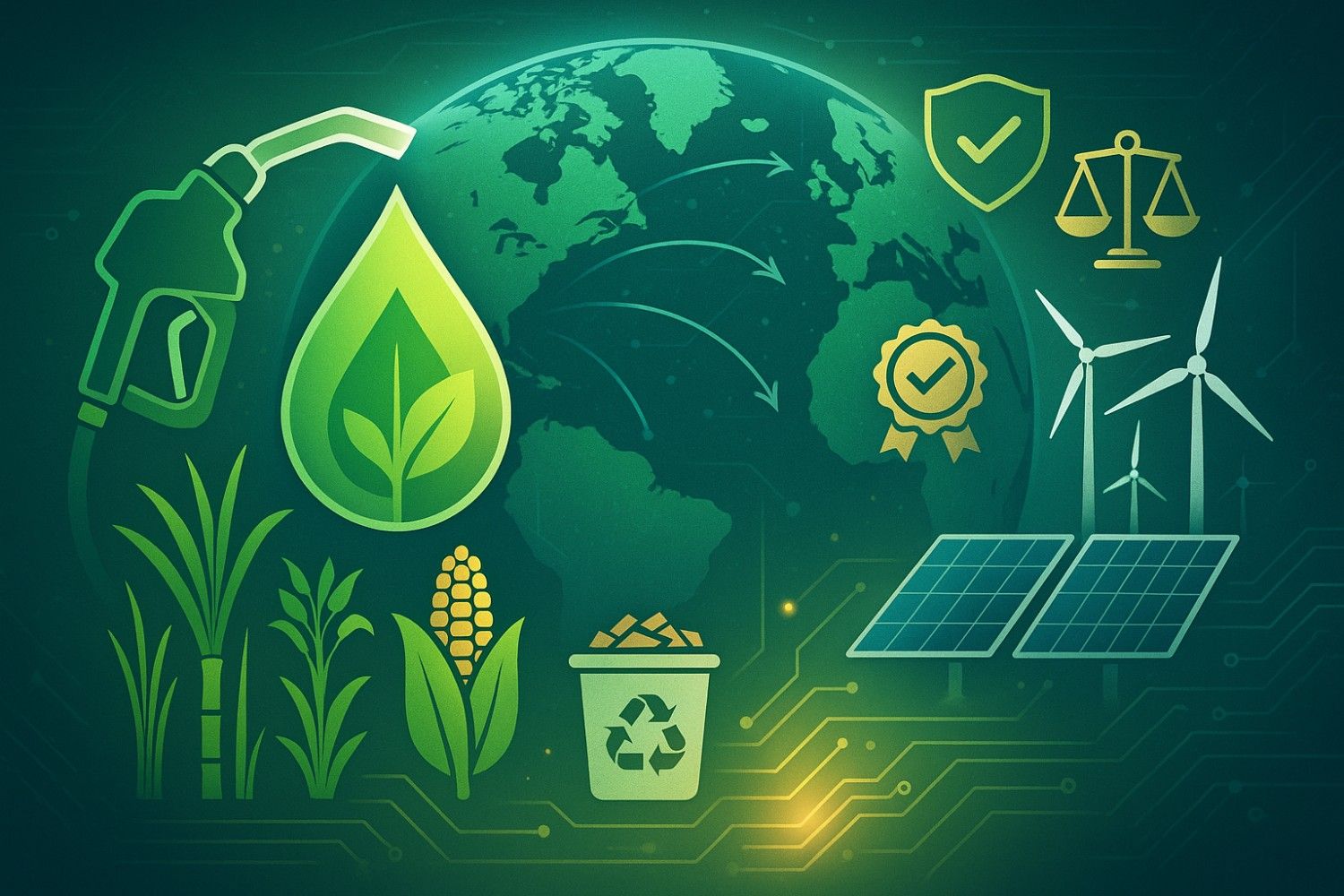
On August 10, World Biofuel Day, the focus shifts to renewable fuels’ potential to address energy security, lower carbon emissions, and promote sustainable growth. Global decarbonization plans heavily rely on biofuels made from waste, biomass, and agricultural residues. Although they hold great promise for the environment, the true obstacle is the compliance environment, which is a complex web of regulations, sustainability standards, and global norms that control the production, distribution, and use of biofuels. Policymakers, producers, and consumers must comprehend these compliance frameworks in order to fully realize the potential of biofuels.
The Global Policy Landscape
Biofuels are regulated through diverse policies worldwide, each shaped by local energy priorities and climate commitments.
European Union (EU): – The Renewable Energy Directive (RED II, now RED III) of the European Union establishes stringent sustainability and greenhouse gas (GHG) reduction standards. For instance, advanced fuels made from waste and residues are eligible for double counting benefits under RED II, whereas crop-based fuels like palm oil are being phased out because of concerns about deforestation. Voluntary programs such as RSB and ISCC EU are used to verify compliance..
United States: – Blending renewable fuels into the nation’s fuel supply is required by the Renewable Fuel Standard (RFS). Using tradable Renewable Identification Numbers (RINs), refiners were required to blend roughly 20.63 billion gallons of renewable fuel in 2022. Additionally, the Low Carbon Fuel Standard (LCFS) in California has accelerated the growth of renewable diesel, where Neste and Phillips 66 are increasing their large-scale production to keep up with demand.
Brazil: – Brazil’s RenovaBio program, a leader in biofuels, uses the RenovaCalc tool to certify producers based on lifecycle carbon savings. Fuel distributors must buy the tradable decarbonization credits (CBIOs) produced by compliance.
India: – The National Policy on Biofuels in India places a strong emphasis on feedstock diversification along with ethanol blending, with the goal of E20 by 2025–2026. Government roadmaps for blending levels and the Bureau of Indian Standards (BIS) for fuel quality are used to monitor compliance.
Standards and Certification
Beyond national policies, technical standards and certification schemes ensure that biofuels meet both quality and sustainability requirements.
Fuel Standards: – For biodiesel, the EU follows EN 14214, while the U.S. uses ASTM D6751. For ethanol, ASTM D4806 defines quality requirements. In aviation, sustainable aviation fuel (SAF) must comply with ASTM D7566, ensuring safety and performance before blending into jet fuel.
Sustainability Certification: – Certification schemes like ISCC EU and RSB play a key role in verifying compliance with sustainability criteria covering GHG reductions, land-use restrictions, and social safeguards. For aviation, the ICAO CORSIA framework sets eligibility rules for SAF, supported by approved certification programs (ICAO, 2021). Airlines such as United and Lufthansa have already conducted commercial flights powered partly by SAF under CORSIA rules.
Lifecycle Assessment (LCA): – Most compliance systems require proof of GHG savings through lifecycle analysis. The EU sets default and actual values under RED, the U.S. LCFS uses carbon intensity scoring, and Brazil’s RenovaCalc quantifies avoided emissions. California’s LCFS, for example, assigns a Carbon Intensity (CI) score to fuels. Renewable diesel from waste fats has achieved CI scores less than half that of petroleum diesel, rewarding producers with higher credit value.
Compliance Challenges
While policies and standards are well established, companies face several real-world compliance hurdles.
- Feedstock Traceability: – There is increasing concern about ensuring that biofuel feedstocks are not associated with biodiversity loss or deforestation. Soon, commodities like palm oil and soy will need to provide geolocation-based proof in order to comply with the EU’s Deforestation Regulation (EUDR).
- Fragmented Regulations: – The EU’s Refuel EU Aviation regulations may require additional documentation for SAF certified under CORSIA, or a fuel batch eligible under U.S. RFS may not qualify under EU RED. For various markets, exporters frequently need to keep up several certifications.
- Chain of Custody Management: – Mass balance system, widely used in biofuels, requires robust auditing to reconcile inputs and outputs. Weak chain-of-custody documentation has led to fraud cases in Europe, with reports of millions of liters of fake biodiesel entering markets under false certifications.
- Quality vs. Sustainability: – Meeting sustainability standards is meaningless if fuels fail to meet technical specifications such as oxidation stability in biodiesel or purity in ethanol.
The Way Forward
In order for biofuels to achieve their full potential, compliance must be regarded as a foundation for trust rather than a regulatory hurdle. Transparent lifecycle accounting, robust digital traceability systems, and stronger international harmonization are essential starting points. Companies need to embed compliance into their strategies from aligning feedstock choices, lifecycle assessment documentation, and fuel-quality testing, while policymakers should work toward mutual recognition of certification schemes.
Biofuels remain central to the global transition toward clean energy. Their long-term credibility and market acceptance depend on the ability to meet technical standards while also demonstrating measurable sustainability gains. On this World Biofuel Day, it is vital to recognize that success in the biofuel sector lies in producing energy responsibly, transparently, and in accordance with international standards. By treating compliance as a catalyst for innovation and trust, biofuels can genuinely deliver on their promise of creating a safer, greener future.
Reference
- https://energy.ec.europa.eu/topics/renewable-energy/renewable-energy-directive-targets-and-rules_en
- https://www.frontiersin.org/journals/energy-research/articles/10.3389/fenrg.2024.1490137/full
- https://www.ieabioenergy.com/blog/publications/biofuels-production-and-development-in-the-european-union/
- https://vajiramandravi.com/current-affairs/biofuel-production-in-india/
- https://testbook.com/full-form/astm-full-form#:~:text=The%20full%20form%20of%20ASTM%20is%20American%20Society%20for%20Testing,products%2C%20systems%2C%20and%20services.
- https://www.ft.com/content/d72a9869-f23a-4ff0-99d2-788f18af96d4